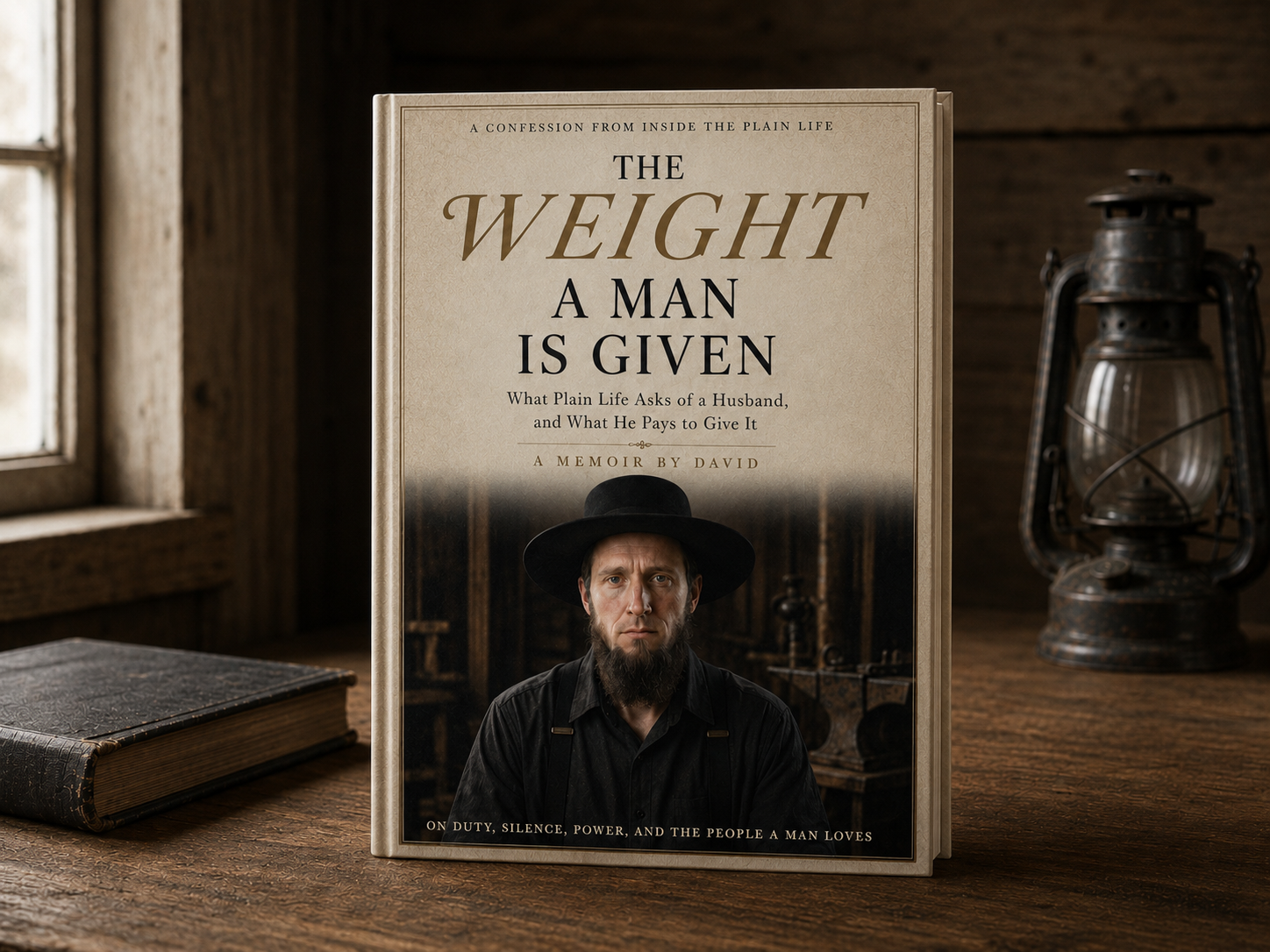
What’s Inside the Book
Ten chapters. Ten objects. One life, run from the head of the table.
Each chapter is anchored to a single physical object — an anvil, a black ledger, a lantern carried down a lane in the dark. Read in order. Or open anywhere.
Chapter 01 / 10P. 1–24
The Anvil
“My father set my hand on the cold iron and told me the three things a husband does. I spent forty years proving him right.”
The anvil. Provide, decide, endure — and how two of the three were never burdens at all, but authority wearing the work clothes of duty.
Chapter 02 / 10P. 25–48
The Boots by the Door
“I rose at four every morning and built the day before anyone could see it being built. I called it service.”
The boots. How a man who arranges the world before the others wake doesn't only serve them — he authors their days, and leaves them no seam to argue with.
Chapter 03 / 10P. 49–72
The Bench at Preaching
“The better I became at holding my face, the more invisible I made the suffering of every man sitting beside me.”
The backless bench. How stillness became standing, how a held face became authority — and how the best holder in the district taught a whole row of men to bury themselves alive.
Chapter 04 / 10P. 73–96
The Black Ledger
“I carry the fear of those figures alone. I tell myself it is kindness.”
The ledger in the bottom drawer. The worst nights, when the columns will not balance — and how keeping the people I love from the truth is also a way of keeping them beneath me.
Chapter 05 / 10P. 97–120
The Unbuilt Room
“I built one room in the house whose true purpose I never told a soul — a place to be unreachable. I built it for myself, and none for the person beside me.”
The hidden room. The secret of every controlling thing he did: tending his own hidden need while staying blind to the larger one of the person beside him.
Chapter 06 / 10P. 121–148
The Lantern at the Lane
“When someone I love sets out from the life, it is in my power to let them go gently or to let them go hard. I have learned what I reach for by reflex.”
The lantern at the end of the lane. The cheap gift handed over in place of the dear one — the lit lamp given to someone I could not bring myself to bless with my own face.
Chapter 07 / 10P. 149–170
The Grieving Clock
“I enforced the clock on a dozen grieving men before it was ever enforced on me. So I had no standing left to refuse it.”
The unspoken schedule that tells a man how long he may grieve. How the most wounded man becomes the timekeeper — and how the chain only breaks if one man refuses to pass it on.
Chapter 08 / 10P. 171–192
The Hands at the Table
“I never once told my family how tired my hands were. I thought my silence was a shelter. It was a lesson.”
The ruined hands, flat on the table at the silent grace. How a father who never says he is tired teaches the children at his table to hide their own — and then mourns that they are closed to him.
Chapter 09 / 10P. 193–216
The Letters I Do Not Give
“There is a stack of letters I have written and never given to the person they are for.”
Writing the truth and hiding it. How the letters are not the proof of my love I once thought — they are the proof of my control, and the silence I weep over is the silence I myself keep.
Chapter 10 / 10P. 217–240
The Thing I Will Not Say I Want
“There is one thing I want and am never permitted to say I want. I do not only deny it to myself.”
The thing beneath all of it — to be known. How a man who cannot bear to be known makes unknownness the law of his house, and calls the taking by the names he was handed: providing, deciding, enduring, love.